
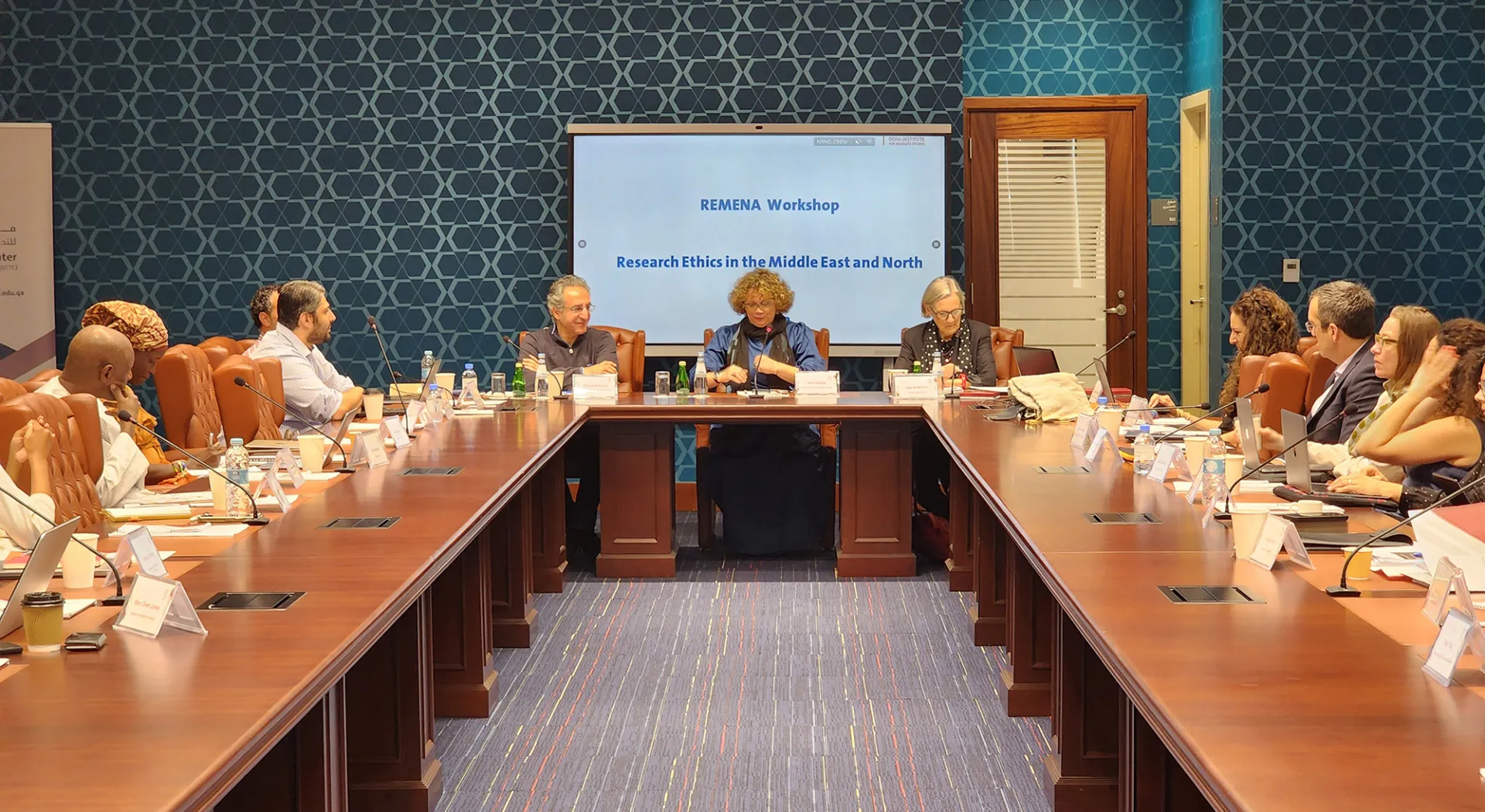
This is the Commission’s report. It is a product of multiple on-line seminars, especially during the COVID pandemic, as well as in-person workshops in Amman, Cairo, Tunis, Doha, Montreal, London and New York, that involved hundreds of colleagues — early career and senior scholars, based in universities, think tanks and consultancies in dozens of countries from New Zealand to Sweden, the United States to Turkey and across the Arab world, representing disciplines ranging from anthropology to statistics to political science. These social science researchers all care deeply about the quality, integrity, and impact of their work and have been willing to share their experiences, satisfactions and concerns, in the furtherance of this collective endeavor.
Reflecting the conviction that no single researcher or research team can ignore or transcend the incentives and hindrances their research environment imposes, this effort examined the context that shapes—and often distorts—decisions about research in the Middle East and North Africa. In that spirit, it proposes responses that reflect the ethical responsibilities that all researchers have to each other and to the broader research enterprise of which they are a part.
The report includes recommendations that should be useful to individual social scientists; advisors and mentors of early career scholars; university departments and research offices; scholarly publishers, including presses and journals; private foundations and other funders; and University leaders.
Those privileged to work in relatively wealthy institutions and in relatively stable and secure conditions should be particularly mindful that their research practices do not exacerbate already deeply hierarchical and unequal research conditions, in both national settings and transnational collaboration.
To that end, we recommend the following measures:
1. Social scientists should be self-conscious and openly reflective about the limits of their epistemologies and conceptual schemes.
2. Regional and site-specific expertise should be regularly deployed in the design and implementation of research programs.
3. Different perspectives on research design and findings should be relayed precisely and respectfully.
4. Collaboration between and across social research communities, particularly opportunities to include early career scholars, should be actively encouraged;
5. Open access to data and data repositories should be standard practice, with appropriate safeguards for privacy and confidentiality.
6. Publications resulting from collaborative research or data collection in the field should be open-access; individual researchers should be provided institutional support for such access.
7. Access to e-libraries and other scholarly resources should be freely available.
8. The specifics of the work of local fixers, research assistants, etc., should routinely be credited, including acknowledgement of the character and extent of their contributions; lists of names in acknowledgements are usually insufficient.
We recommend that:
1. All research proposals should be the subject of a discussion with experienced re- search scholars about not only the methods, but the ethical obligations entailed in the research.
2. In developing their proposals, researchers should critically engage with the literatures from the region.
3. Content covering principles of ethical research, including issues of field research power dynamics, safety in the field, extractive knowledge production, etc., should be included in all graduate and post-graduate methodology training.
4. Research designs, including doctoral dissertations, should permit and perhaps encourage undertaking collaborative work, and such collaborators should be acknowledged appropriately.
5. Research that purports to be founded on regional content, expertise or impact should require, and utilize, immersive field-work experience and appropriate language competence.
6. Training and mentoring reflect the reflect the work and findings of social science conducted outside universities and academic research centers.
7. Departments that train social scientists should develop collaborative and reciprocal institutional partnerships, particularly across regions (e.g. North America and the Middle East), to enhance exchange of ideas, methods, contacts and expertise.
While we recognize the value of institutional review of research, for both the institutions and researchers, the limitations of the conventional Institutional Review Board system have created as impediments to both the design and the conduct of responsible research in the Middle East and North Africa. Many such review processes, including requirements of pre-registration of research plans, fail to recognize the interactive, collective and shared character of social science research, which reflects iterative collaborations between social scientists and the social communities they study. To rectify these problems, we recommend that:
1. Research reviews should utilize language that attributes agency to the researched — active “participants” rather than passive “subjects” — and acknowledges disruptive potential beyond the specific character of the “treatment” and the limited moment of the research.
2. Institutional reviews should be conducted by boards with appropriate expertise in field research, even if that requires cross-institutional review boards or external reviewers, while risk management training modules and online curricula should include examples from appropriate contexts.
3. Research review boards should encourage research designs that embody an ethic of participation and partnership, including collaborative processes of question-generation, when possible.
4. Consideration of the safety of researchers, research participants and even third parties in the field should extend beyond the specific research site to the contexts in which the research will be evaluated and disseminated, where academic freedom may be compromised, including Europe and
North America.
5. Professional associations such as American Political Science Association, the American Sociological Association, the Middle East Studies Association, and others that provide their members with practical guidelines tailored to their disciplines should incorporate these recommendations.
Making research findings clear, accurate and accessible is necessary to ensure accountability and impact, as well as the advancement of knowledge more broadly. To ensure that research is well and
widely shared, we recommend that:
1. While taking care not to violate confidentiality protocols, researchers should expect to disseminate findings not only to professional audiences but provide reports of the findings to the communities in which the research took place, in languages and formats that are clear and accessible to them.
2. Publishers, journals, dissertation repositories, etc., should ensure that abstracts and executive summaries are available in a language of the region.
3. Scholarly journals require disclosures of research assistance, collaborations, as well as funding, recognizing the necessary balance between transparency and confidentiality.
4. Book publishers and journal editors ensure a wide and knowledgeable pool of reviewers; concerns about declining availability of reviewers may be addressed by expanding the pool of prospective reviewers to colleagues working outside North America and Europe.
5. Journal editors inquire about the availability of relevant literatures in the languages of the region and encourage authors to include non-English sources to ensure more comprehensive and locally grounded scholarship.
To ensure that research of genuine novelty and importance is funded, we recommend that:
1. Funders should develop funding priorities in consultation with one another and with the wider research community, to avoid both oversaturation and neglect of important agendas.
2. Funders should extend their networks and support beyond their usual grantees, including providing assistance in the technical writing of their required proposals.
3. Diversification of the themes and disciplines supported, including reversal of the declining funding for humanities and the social sciences, should be a priority for funders.
4. Funders should strengthen ethical review of the projects they support.
5. Funders should support not just individual research projects but institutions in the Middle East and North Africa through direct aid and collaborative grants, both with North American and European partners and with institutions elsewhere in the Global South.
6. Funders should require and allocate funding for effective and consequential dissemination, particularly translation from local languages to English (and vice-versa), support of local access to journals and databases.
7. Engagement with citizens, policymakers, and others at the site of the study and beyond should be encouraged, if not required.
As the declaration of the Magna Charta Universitatum insists, “Universities question dogmas and established doctrines and encourage critical thinking in all students and scholars. Academic freedom is their lifeblood; open inquiry and dialogue their nourishment.” To that end, we urge that:
1. Institutional leaders should rededicate themselves and their institutions to the principles of academic freedom, including in the words of the Magna Charta Universitatum:
a) The first principle was independence: research and teaching must be intellectually and morally independent of all political influence and economic interests.
b) The second was that teaching and research should be inseparable, with students engaged in the search for knowledge and greater understanding.
c) The third principle identified the university as a site for free enquiry and debate, distinguished by its openness to dialogue and rejection of intolerance.
2. University and other institutional leaders should establish clear policies and guidelines that promote and uphold the principles of academic freedom in practice.
3. Universities should work with government agencies in the Middle East and North Africa to ensure that both academic and non-academic social research is conducted ethically and responsibly while discouraging government involvement in evaluating topics, methods or personnel involved in social research.
4. Universities and other institutional leaders should collaborate to protect and promote academic freedom across the world — including within North America, Europe and the Middle East and North Africa.