
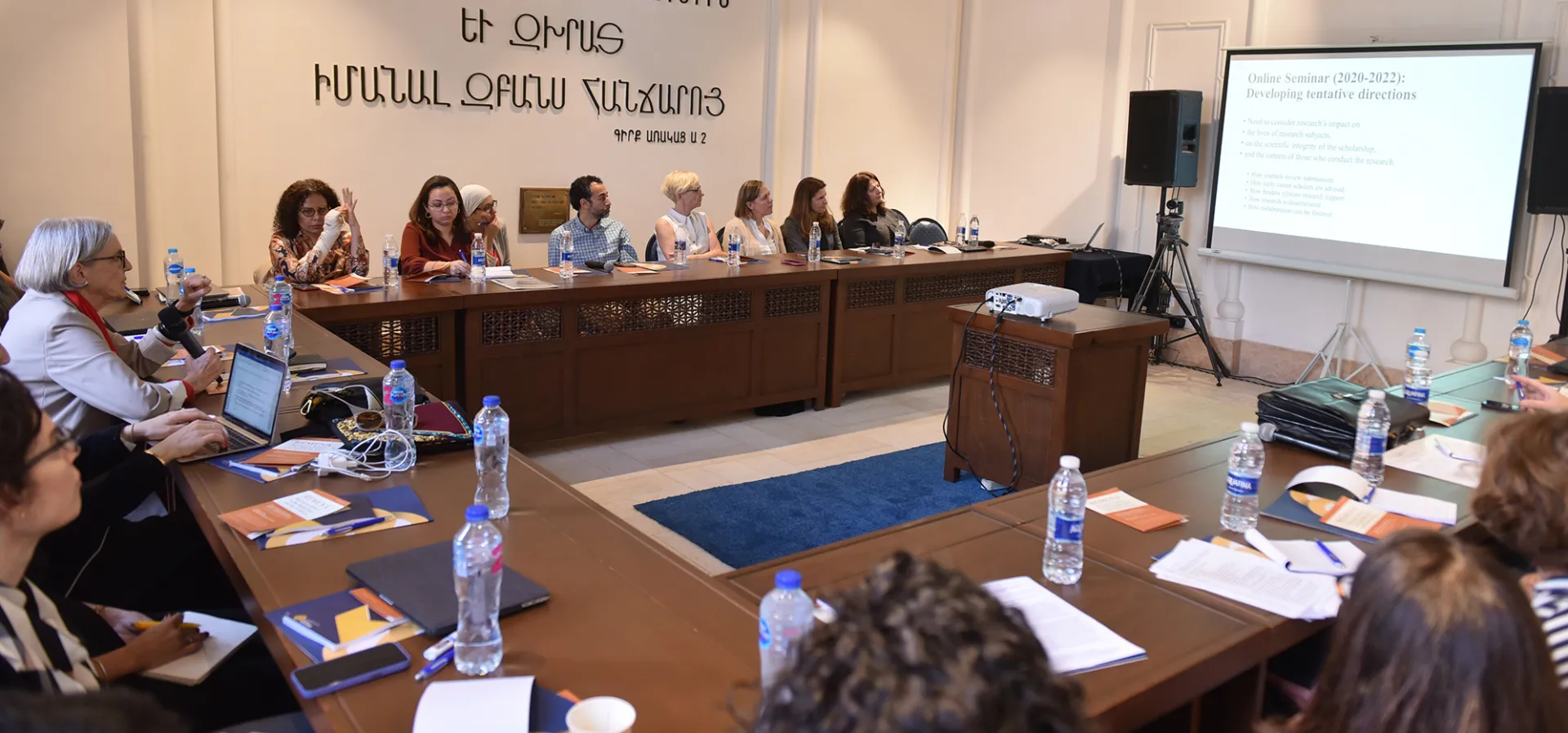
This section encompasses articles and research published as a direct result of the Research Ethics in the Middle East and North Africa initiative. Moreover, it also includes resources that informed the project's endeavors from its beginning
REMENA Articles in Daedalus
Abstract
REMENA was intended to animate an interdisciplinary network of scholars to assess the landscape of social science research conducted largely in the Arab world, particularly some of the ethical, political, and economic challenges to conducting such research responsibly. It reflected many ongoing discussions, frustrations, and initiatives by mena scholars in the region as well as in Europe and North America. The aim was twofold. First, the commission sought to raise awareness about the structural contexts of social science research in the Middle East and North Africa. Then, working with academics, researchers, and practitioners, the commission set out to develop responses and remedies for the deficiencies identified, and to develop ethical standards to improve the quality and strengthen the communities of social science research on, and in, the Middle East and North Africa.
Abstract
To illuminate the context within which the rest of the contributions of this volume are located, we provide a historical perspective on the development of “Middle East studies” in the modern university. Arguing that this history reflects both the varied and rarely congruent political contexts and the converging institutional evolution of universities globally, we examine how the study of the Middle East and North Africa illustrates an uneasy tension in simultaneously fostering critical inquiry, producing educated elites, serving national interests, meeting international markets, and producing truly global knowledge. These different aims of the university not only exist in tension but might, under certain conditions, become actual contradictions. We may be experiencing such a moment of contradiction at the present time, both in the United States and in the Middle East and North Africa itself.
Abstract
Social science research on the Middle East and North Africa depends heavily on external funding. In this essay, we consider the implications of this reliance. In our review of calls for proposals and 924 grants and projects from 23 organizations, we find that this funding often centers the issues that Western policymakers view as salient but does not necessarily reflect the major concerns of those in the region; the funding recipients favor political science, leaving other disciplinary perspectives less developed; and the funding focuses heavily on select countries, while others remain understudied. Our investigation also uncovered a lack of coordination in funding that, combined with a fragmented research landscape, impedes knowledge accumulation. We conclude our findings with recommendations for steps that can be taken to overcome these problems.
Abstract
Disseminating new research findings and integrating them into future research are crucial tasks for cumulative knowledge production. We address the challenges of dissemination and integration of research in the social sciences of the Middle East and North Africa region, where scholarship written in Arabic is often overlooked by scholars writing in English. Although this marginalization reflects differences in taste, quality, method, and theory, some of the hierarchy is due to English-language scholars’ lack of awareness of relevant Arabic-language work. This ignorance is perpetuated by inaccessibility. We propose an open-source translation tool to aggregate relevant articles based on artificial intelligence models to lower the cost of cross-language literature review. If English-language researchers are willing to commit to the ethical value of integrating work published in local languages, recent technological developments make it feasible.
Abstract
In the post-Cold War era, “Islamic terrorism” has taken the place of the Communist threat. The Middle East, a construct developed in nineteenth- and twentieth-century European colonialism, is the region from which this threat is said to emanate. Teaching politics of the Middle East is therefore by definition a political endeavor: even if students arrive to the classroom with very little factual knowledge about this region, they will, through media portrayals, inevitably bring a certain image of the region and its inhabitants. In this essay, I examine ways educators can promote critical, self-reflective connected decolonial thinking. I argue for the importance of a critical theoretical toolkit, drawing on anticolonial pedagogy and self-reflective praxis. Teaching in universities of the Global North to a mostly white, non—Middle Eastern student body, I encourage students to embrace self-reflexivity and develop embodied and connected feminist learning skills through self-reflective journaling.
Abstract
This essay analyzes the institutional management of field-intensive social science research in U.S.-based universities. I argue that administration and mentorship of field-intensive projects at the department and university level encompass well-known perverse incentives, pedagogical pitfalls, risks, and concurrent consequences for knowledge production. I outline three common ideal-typical models: the Indiana Jones model, the legal-securitization model, and the Procrustean design model. Specifically, I elucidate the underlying priorities, the nature of mentorship, the relationship to rules and norms, the approach to ethics, and the systems of administrative power embedded in each. Further, I discuss the consequences that result from the dominance of these three models of scholarship, including the pathologization of particular regions, the sensationalization of particular research topics, and the channeling of knowledge production by external priorities rather than intellectual merit.
Abstract
The essay draws on my experience in an international research project exploring the concept of vulnerability within the international protection regime and the work of formulating a new institutional ethical review process at the Centre for Lebanese Studies. I draw on my experiences to explore the ethical consequences of using vulnerability as a lens to assist and understand refugees in policy and in research. I identify the main ethical dilemmas we faced in the context of our research project and in the institutional ethics review processes and ethical scholarship more generally to reflect on the contested and often charged meanings and uses of concepts such as “vulnerability” and categories like “refugees.” The essay also shows how refugees themselves relate to these meanings and practices.
Abstract
Drawing on thirteen years of personal experience researching Middle Eastern politics, I examine how digitality has eroded traditional boundaries between safety and danger, public and private, and democratic and authoritarian spaces. While digital tools initially promised to make research more accessible and secure, they have instead created new vulnerabilities through sophisticated spyware, state-sponsored harassment, and transnational repression. These challenges are compounded by the neoliberal university, which pushes researchers toward public engagement while offering little protection from its consequences. Moreover, the integrity of digital data itself has become increasingly questionable, as state actors and private companies deploy bots, fake personas, and coordinated disinformation campaigns that create “authenticity vacuums ” in online spaces. This essay argues that these developments necessitate a fundamental reconsideration of digital research methodologies and ethics, offering practical recommendations for institutions and researchers to navigate this complex landscape while maintaining research integrity and protecting both researchers and their subjects.
Abstract
As the Middle East and North Africa (MENA) is becoming a lab for randomized controlled trials in the social sciences, this essay reflects on the use of this methodology in the region. Reflecting on earlier critiques of the method’s deployment in the Global South, we argue that the perils of its use outweigh the benefits. Unlike many of the existing critiques, we maintain that this methodology’s intrinsic flaws are further exacerbated in the context of mena, and that its shortcomings cannot be mitigated by safeguards. So instead of trying to further refine it, researchers should seek alternative methods.
Abstract
The language that researchers use to describe the increasingly violent reality in Gaza has become a contested space. Analytical terms like “genocide,” “self-defense,” “terrorism,” and “resistance,” while not inherently normative, have become tests of political loyalty. This reflects a broader struggle over the dominant narrative, particularly evident in Germany, where semantic disputes have hindered scholars ’ ability to contribute meaningful analysis to public debates. Amid shrinking spaces for critical inquiry, we highlight the responsibility of scholars to counteract the expanding semantic void surrounding the Gaza war and the events of October 7 by advocating for an ethical representation of violence that honors the experiences of those affected. This responsibility rests on two foundations: 1) academic integrity, which requires naming, explaining, and contextualizing violent phenomena independent of political agendas, and 2) an ethical commitment to convey the lifeworld of research partners in terms of the meanings they attribute to it, without applying linguistic filters that distort these meanings.
Abstract
I argue that despite becoming a buzzword appropriated by many, “decolonizing” is an intellectual and political project with which social researchers, including those who work on the Middle East and North Africa (MENA), should reckon. Sampling from a particular strand of decolonizing work, which came to be labeled the “Indigenous turn” in anthropology, the essay looks for what might be relevant for the ethics and practices of current social research on, and in, MENA. I also consider some cautions voiced by scholars who-with no illusions about the possibility of value-free social science or scholarship-are wary of the risks of too quickly collapsing politics and academic scholarship into each other.
Abstract
The American definitions of “race” and “racism,” which often conflate academic and lay conceptions, have been exported with American social science into debates of race in the Middle East and Africa. These definitions assume that the American distinction between race, as primarily about skin color, and ethnicity, as denoting cultural difference, is universally accepted. Over the past fifty years, a semantic shift in American academia and society has redefined race from a biological term to a social construct, further confounding its use as the concept travels outside the U.S. context, imposing American understandings of difference. This confusion has both scholarly implications and political consequences.
Abstract
International development organizations regularly commission social scientific studies to inform countries’ strategies and programming. While they are expected to be policy relevant, these studies can suffer from limitations related to how they are justified, framed, funded, and used, relying on levels of expertise essentially determined by commissioning organizations. With a focus on Jordan, I explore ethical dimensions of nonacademic research within the development sector. This essay is meant to be a reflective piece that draws on my personal experience as a development practitioner as well as interviews with representatives of consulting firms, academic organizations, and donors in Jordan.
Abstract
This essay examines the distortions introduced into research agendas and research design by the effort to avoid seeming “political.” The rhetorical, institutional, and disciplinary operations of the social science research enterprise worldwide serve to divert attention from questions of power and collective accountability to a focus on technical interventions, institutional risk, and individual responsibility. These practices coincide with the specific circumstances of social science research in the Middle East and North Africa-where the exercise of political power in the form of international interference, irresponsible autocracy, civil disorder and violence, and protracted economic poverty and duress is difficult to conceal-to shape research terrains and agendas, and create a particularly, and tellingly, troubled research environment.
Abstract
Research ethics is an increasingly important part of social science debates. Among political scientists conducting research in the Americas, much of this discussion focuses on the ethics of experiments with human subjects. The ethical challenges identified by remena (Research Ethics in the Middle East and North Africa) scholars clearly overlap with those faced by researchers elsewhere, but they also involve unique issues specific to the mena region. Broad themes include power and authoritarianism, technocratic versus activist research, ownership of ethicality, and communicating clearly and honestly with vulnerable populations.
Abstract
Drawing on the essays in this volume of Daedalus, as well as REMENA (Research Ethics in the Middle East and North Africa) workshops and meetings over the last several years, we reflect on what constitutes responsible social inquiry. We present the context for a “call to action” for universities, foundations, and other funders, publishers, and researchers. Through procedural, professional, and political recommendations, we offer guidance to address some of the ethical dilemmas in designing, monitoring, funding, conducting, and disseminating social science research on the Middle East and North Africa-and beyond.
REMENA Articles in Global Perspectives
Abstract
In the Middle East and North Africa, where most states have their origins in colonial regimes that supplied research for their own imperial purposes, the utility of university-based social research in informing public policy has never been uncontested. Continuing ambiguity about the status of the region and of its constituent units in global affairs both reflects and shapes the conduct of social science research. The absence of a widespread notion of the public, the public interest, or the public good as a reference for governments - the absence, in other words, of citizenship rights and democratic accountability - contributes to the confusion about the audience for the research that is conducted. This collection showcases novel interpretations and approaches that transcend persistent challenges to social research in the Middle East and North Africa.
Abstract
The essay reflects on the study of social movements and contentious politics in the Middle East and North Africa region, especially after the wave of uprisings that started in 2011. It argues that these uprisings have been a watershed in contentious politics, yet they have not been adequately scrutinized to develop existing theoretical paradigms in mainstream sociology and political science. Rather, these events were mostly straitjacketed to fit the predominant paradigms of democratic transitions and social movement theory. It concludes by providing preliminary reflections on how the currently dominant methodologies and epistemologies in social sciences might be limiting theoretical development informed by events outside the global North.
Abstract
The study of political culture in the Arab world presents us with a paradox: albeit cultural explanations of Arab politics by Western scholars (e.g., Huntington 1993) have been widely criticized from within the region as latter-day Orientalist views, the cultural approach remains one of the leading analytical approaches employed in Arab social sciences. Central to this tradition is the idea that Arab societies have specific cultural characteristics that contribute to, or are the cause of, the region’s general “backwardness,” especially politically. Collectively known as critics of al-turāth (cultural heritage), this school of thought sparked important scholarly debates in Arab academic circles. This paper reflects on these debates, mainly focusing on how Arab political science, broadly defined, has considered the role of culture as a potential explanatory variable for the endurance of authoritarianism in the Arab world and the failure of democratic transitions. Several influential Arab intellectuals adopt the cultural approach, but they do not necessarily define culture in static, primordial, or fixed terms. If Arab political culture is deemed problematic, it can still be changed. For this academic tradition, the “critical intellectual” is a central agent for any sociocultural and political change.

Abstract
Recent Western literature concerning the political determinants of economic and social outcomes has primarily concentrated on regime types and the effectiveness of state institutions. While this literature has been influential among scholars of and in the Middle East and North Africa, there has also been an emphasis in the region on the interests and networks of economic and political elites—the interactions between rulers, elites, and the broader citizenry—to explain divergent policy outcomes. This is largely due to the inability of dominant mainstream institutional and structural theories to explain much of what has been observed in the region, viewing it as exceptional in its authoritarianism and resistance to global trends. In fact, the seeds for a more sophisticated understanding can be found in the literature on the Arab world that emphasizes relational dynamics between political and economic actors. Synthesizing the insights of scholars of the region has the potential to contribute more broadly to global debates on how political factors and conditions within states shape the quality of life experienced by their residents. Such a shift to viewing regimes as networks provides a useful framework for bridging the broader trends in political science with the work emanating from scholarship on the Middle East and North Africa.
Abstract
In recent years, the rise of the knowledge economy has paved the way for a change in the dynamics of knowledge production. This has been translated into two contradictory trends: (1) the commodification of knowledge production and (2) connecting social sciences to society, necessitating that academics go beyond their traditional role of teaching and research to engage wider publics in contemporary critical debates. Based on a survey of grantees of the Arab Council for the Social Sciences, this article considers the case of Arab social researchers by looking at their research outcomes beyond “academia,” identifying the forms of dissemination of their research and how they engage in dialogue with the public. Compared to previous research done on this topic, the findings demonstrate considerable engagement of their research, which is contributing to the reconciliation of knowledge production and use. Changes are seen not only in the scope of engagement but also in the use of different styles of expressions and deployment of topics. The survey and the interviews allow us to understand the challenges the researchers face, whether these are structural (political, institutional, and socioeconomic) or cultural.
Abstract
Public policy studies in the Middle East and North Africa region are usually conducted either inside academic setups or within specialized and/or interdisciplinary research centers and think tanks. The field is considered relatively new, and up to this day the term may not be totally clear to the layperson. The context in which policymaking occurs in many parts of the region is not only complicated, taking into consideration the many near-failed states, but also characterized mostly by ambiguity and lack of transparency. The aim of this article is to look at some indicative trends and explore the what, where, and how of policy studies in the region, highlighting key challenges faced and achievements realized.
Abstract
In this reflective essay, the author assesses how the Middle East and North Africa (MENA) region has been studied, taught, and theorized from in the fields of Security Studies and Critical Security Studies. The principal question guiding the essay is What do different traditions in Security Studies have to tell us about conflict in the Middle East and North Africa? The essay seeks to reflect on how the region, its peoples, and their experiences are incorporated into these fields and how this has shaped scholarly and popular understandings of conflict and peace in the MENA. The attention is then shifted to a discussion of how the emergent scholarship on non-Western IR and other approaches from within the MENA region itself may contribute to different ways of researching and teaching conflict and security in the MENA. The analysis concludes with some observations about the future of conflict and security studies in the MENA with an emphasis on key questions that are raised in the context of the region’s contemporary overlapping crises.
Other REMENA Articles
Abstract
Political science arrived comparatively late to conversations regarding fieldwork safety. Professional fields such as journalism and humanitarian aid began providing practical training—including first aid and risk assessment strategies—to employees deployed to violence-affected, repressive, and unstable contexts starting in the 1990s (Lake and Parkinson 2017). Like their colleagues in other fields, academics often travel to remote places, examine contentious topics, and rely heavily on local buy-in for access and safety. Even as research in such sites has increased, many scholars report feeling practically unprepared for their fieldwork (Cronin-Furman and Schwartz 2020).
REMENA Resources
The following sections encompass important resources that informed REMENA endeavors
Recommended articles
- Abaza, M. 2011. “Academic Tourists Sight-Seeing the Arab Spring.” AhramOnline. September 26.
- Allam, H. 2019. “‘It Gets to You.’ Extremism Researchers Confront the Unseen Toll of Their Work.” NPR.org. September 20.
- Al-Hardan, A. 2017. “Researching Palestinian Refugees: Who Sets the Agenda?” Al-Shabaka (blog). April 27.
- Ansoms, A., Murison, J., & Thomson, S. M. 2013. Emotional and ethical challenges for field research in Africa the story behind the findings. Palgrave Macmillan.
- Baele, S. J. et al. 2018. “The Ethics of Security Research: An Ethics Framework for Contemporary Security Studies.” International Studies Perspectives. 19(2): 105–127.
- Baganda, S. B. 2019. “The ‘Local’ Researcher - Merely a Data Collector?” Oxfam Blogs: From Poverty to Power. August 20, 2019.
- Blee, K. M., & Vining, T. 2010. Risks and Ethics of Social Movement Research in a Changing Political Climate. In P. G. Coy (Ed.), Research in Social Movements, Conflicts and Change (Vol. 30), pp. 43–71. Emerald Group Publishing Limited.
- Bouka, Y. 2019. “Considering Power Imbalances in Collaborative Research.” Rift Valley Institute: Essays and Reviews. May 15.
- Bouka, Y. 2018. “Collaborative Research as Structural Violence.” Political Violence at a Glance.
- Brand, L. 2014. “Of Power Relations and Responsibilities.” POMEPS Studies 8: The Ethics of Research in the Middle East. Washington, DC: Project on Middle East Political Science.
- Campbell, S. P. 2017. “Ethics of Research in Conflict Environments.” Journal of Global Security Studies. 2(1), 89–101.
- Cirhuza, E., Bahati, I., Précieux, T., & Ansoms, A. 2020. “Contracts and Lived Experiences of Global South Local Researchers.” Africa at LSE (blog). June 11.
- Clark, Janine A. and Francesco Cavatorta. 2018. Political Science Research in the Middle East and North Africa: Methodological and Ethical Challenges. New York, NY: Oxford University Press.
- Clark, Janine A. 2012. “Fieldwork and Its Ethical Challenges: Reflections from Research in Bosnia.” Human Rights Quarterly, 34(3), 823–39.
- Clark, T. 2008. ‘‘We’re Over-Researched Here!’ Exploring Accounts of Research Fatigue within Qualitative Research Engagements.” Sociology, 42(5), 953-970.
- Cronin-Furman, K., & Lake, M. 2018. “Ethics Abroad: Fieldwork in Fragile and Violent Contexts.” PS: Political Science & Politics, 51(3), 607-614.
- Curtis, D. A. 2019. “What Is Our Research For? Responsibility, Humility and the Production of Knowledge about Burundi.” Africa Spectrum, 54(1), 4-21.
- Denney, L., & Domingo, P. 2015. “Turning the Gaze on Ourselves: Acknowledging the Political Economy of Development Research.” Humanity Journal Blog. December 4, 2015.
- Desai, D., & Tapscott, R. 2015. “Tomayto Tomahto: The Research Supply Chain and the Ethics of Knowledge Production.” Humanity Journal Blog. December 3, 2015.
- Eck, K., & Cohen, D. K. 2021. “Time for a Change: The Ethics of Student-led Human Subjects Research on Political Violence.” Third World Quarterly, 0(0), 1–12.
- Eriksson Baaz, M., & Utas, M. 2019. “Exploring the Backstage: Methodological and Ethical Issues Surrounding the Role of Research Brokers in Insecure Zones.” Civil Wars, 21(2), 157–178.
- Fujii, L. A. 2012. “Research Ethics 101: Dilemmas and Responsibilities.” PS: Political Science & Politics, 45(4), 717–23.
- Grimm, Jannis et al. 2020. Safer Field Research in the Social Sciences: A Guide to Human and Digital Security in Hostile Environments. SAGE Publications Ltd.
- Habib, R. R. 2019. “Ethical, methodological, and contextual challenges in research in conflict settings: The case of Syrian refugee children in Lebanon.” Conflict and Health, 13(1), 29.
- Marshall, S. 2019. “Scholars, Spies and the Gulf Military Industrial Complex.” Middle East Report Online. September 4, 2019.
- Masterson, D., and Mourad, L. (2019). “The Ethical Challenges of Field Research in the Syrian Refugee Crisis.” APSA MENA Politics. 2(1).
- Mazurana, Dyan, Karen Jacobsen, and Lacey Andrews Gale, eds. 2013. Research Methods in Conflict Settings: A View from Below. Cambridge: Cambridge University Press.
- Nordstrom, C., & Robben, A. C. G. M. 1995. Fieldwork under fire : contemporary studies of violence and survival / Edited by Carolyn Nordstrom, Antonius C.G.M. Robben. University of California Press.
- Parkinson, Sarah E. 2022. “(Dis)Courtesy Bias: ‘Methodological Cognates,’ Data Validity, and Ethics in Violence-Adjacent Research.” Comparative Political Studies 55(3): 420–50.
- Parkinson, Sarah E. 2014. “Practical Ethics: How U.S. Law and the ‘War on Terror’ Affect Research in the Middle East.” POMEPS Studies 8: New Challenges to Public and Policy Engagement. Project on Middle East Political Science: Washington, DC.
- Parkinson, Sarah E. 2017. “Through the Looking Glass: Information Security and Middle East Research.” POMEPS Studies 24: New Challenges to Public and Policy Engagement. Project on Middle East Political Science: Washington, DC. March 13.
- Parkinson, Sarah E. 2015. “Towards an Ethics of Sight: Violence Scholarship and the Arab Uprisings.” LSE Middle East Center Blog. August 26, 2015.
- Parkinson, Sarah E., & Wood, E. J. 2015. “Transparency in Intensive Research on Violence: Ethical Dilemmas and Unforeseen Consequences.” Qualitative & Multi-Method Research. 13(1), 22–27.
- Pittaway, E.; Bartolomei, L., & Hugman, R. 2010. ‘‘Stop Stealing Our Stories’: The Ethics of Research with Vulnerable Groups.” Journal of Human Rights Practice. 2(2), 229–251.
- Project on Middle East Political Science. 2014. POMEPS Studies 8: The Ethics of Research in the Middle East.
- Rychnovská, Dagmar. 2016. “Governing Dual-Use Knowledge: From the Politics of Responsible Science to the Ethicalization of Security.” Security Dialogue 47(4): 310–28.
- Sriram, Chandra Lekha. Surviving Field Research: Working in Violent and Difficult Situations / Edited by Chandra Lekha Sriram [and Others]. London; Routledge, 2009. Print.
- Subotić, J. 2020. “Ethics of Archival Research on Political Violence.” Journal of Peace Research. 1–13.
- Sukarieh, M., & Tannock, S. 2013. “On the Problem of Over-Researched Communities: The Case of the Shatila Palestinian Refugee Camp in Lebanon.” Sociology. 47(3), 1-15.
- Sukarieh, M., & Tannock, S. 2019. “Subcontracting Academia: Alienation, Exploitation and Disillusionment in the UK Overseas Syrian Refugee Research Industry.” Antipode 51, 664-680.
- Wackenhut, A. F. 2018. “Ethical Considerations and Dilemmas Before, During and After Fieldwork in Less-Democratic Contexts: some Reflections from Post-Uprising Egypt.” The American Sociologist, 49(2), 242-257.
- Yadav, Stacey Philbrick. 2023. Yemen in the Shadow of Transition: Pursuing Justice Amid War. Oxford: Oxford University Press.
"The publics in the Arab world are heterogeneous and disconnected from each other. This rupture between policymakers, activists, researchers, government organizations, and the lay public complexifies the models persisting in the Arab world. For policymakers and government organizations, the issue is not in the deficiency of knowledge as much as in the application of research and in moving beyond the findings to create a dialogue." - Alaa Khaled & Sari Hanafi